Module 2 - Aligning Projects with Assessment Standards
One way of engaging learners in higher-order thinking is through the use of projects. Projects provide an authentic and real-world context for connecting learning activities and incorporating higher-order thinking around big ideas. In this module, you will identify standards, explore how ICT-supported projects can be used in the classroom, determine the type of planning that is required, and begin planning your own project.
Activity 2.1
Identifying Assessment Standards
To begin with the end in mind means to start with a clear understanding of your destination. It means to know where you're going so that you better understand where you are now so that the steps you take are always in the right direction. - Stephen R. Covey, The 7 Habits of Highly Effective People |
Step 1: Considering the Steps for Project Planning
To be successful, projects need to be designed with the end in mind. Without closely focused learning outcomes, the purpose of the project can become unclear and expectations for learning outcomes can be miscommunicated. When designing projects, always ensure that the activities planned will help your learners meet the intended learning outcomes. At a very basic level, project planning involves four steps.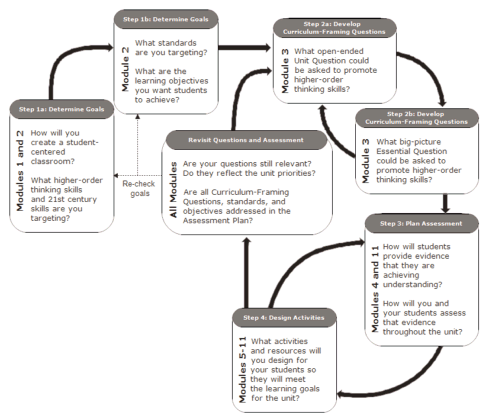
-
Determine specific assessment standards by using curriculum statements and the desired higher-order thinking skills.
- From your assessment standards and your own high expectations, what is it that you want your learners to be able to know, do, or understand?
- What higher-order thinking skills do you want to target?
- Develop Curriculum-Framing Questions.
- What is the big idea in those targeted assessment standards?
- What Critical, Focus, and Content Questions will you use to help focus the learning for your learners?
- Make an assessment plan.
- How will you know your learners have met the learning outcomes?
- By what criteria will learners be assessed?
- What methods of assessment will you use throughout the project in order to inform you and your learners about their learning progress?
- What reporting and monitoring methods will you use to
encourage learner self-management and progress during independent and
group work?
- Design activities.
- What scenarios will you develop to provide rich learning opportunities to help learners meet the learning outcomes?
- How can you involve learners in problem solving investigations or other meaningful tasks that will help answer the Curriculum-Framing Questions and establish connections to life outside the classroom and address real-world concerns?
- How can ICT be used to enhance learning? How will you manage your learners' use of ICT?
- What tools will be provided to help learners manage project tasks, timelines, and group work?
This simple four-step process is deceiving. Project planning is not
linear; it always involves circling back to the previous steps to
ensure alignment. The use of Curriculum-Framing Questions (the focus of
Module 3) and a project approach should all work together to support
the learning outcomes and targeted assessment standards of the project. Throughout the
project, there should be multiple opportunities for assessment and
monitoring to measure your learners' progress.
Note: You may also want to review the project planning resources available at: www.intel.com/education/designprojects Click Enter. Click Project Design, and then click Planning Projects. |

